
Moving from self-blame to self-love
By redefining the Niyama 'Tapas'

I felt an ache in my lower back and pins and needles in my legs, but I wouldn’t move, I had always taken pride in my self-discipline. Surely if I wanted to be a yogi, I should be able to sit through such discomforts. I was sitting cross-legged on the floor at my favourite class during my yoga teacher training: Yoga philosophy (at One Yoga, Thailand). These classes showed me glimpses of the vast and rich tradition of yoga, which helped me better understand why yoga had such an impact on my life.
I rarely interacted in the classes but instead listened to soak up as much information as I could, and reflect on them afterwards. Whilst my mind was considering changing the position of my legs, I heard the teacher asking for the meaning of ‘Tapas’ (one of the Niyama’s – the personal practices/ethics as described in Patanjali’s Yoga Sutras). Unlike my usual silence I said the words ‘discipline’ and ‘austerity’, after all I had been living by this Niyama long before the teacher training. The teacher looked at me and said he preferred seeing it as ‘the love of practice’.
His answer confused me ‘the love of practice’? Why that word ‘love’? It seemed so far removed from my experience of discipline. My discipline had always had this harshness in it, possibly even a punishing undertone and a denigrating self-talk. I used discipline because I’m lazy, because I’m not flexible, because I’m too anxious, because I’m weak, because I feel no love for myself and I want to become someone I can love. I started to realise during my teacher training that my personal growth was fuelled by self-blame rather than self-love, by fighting myself rather than surrendering. His words stuck in my mind and made me realise I had to change in order to keep growing.
Self-love is one of those words which we hear so often, and we might intellectually understand but not always embody. Before my teacher training, I had already started to experience moments in which I felt empathy towards myself, but simultaneously I would still put myself down. Patterns, like negative self-talk, are hard to break and instead of breaking free from it, I used it as fuel to my discipline. I was proud of my discipline, of how I practiced yoga and meditation every day, how I’d take cold showers, how I faced my fears, did rigorous excercises or restrictive diets.
During and after the teacher training I started to investigate that harshness in my discipline, where did it come from and why did I act with such self punishment? A lot of it came from anger towards myself, I blamed myself for spending years in a life which wasn’t good for me. I also blamed myself for how I dealt with trauma and the consequent issues of it such as panic attacks, dissociation, anxiety and night terrors. Most of all, I felt angry at myself for all the times I didn’t speak up when people hurt me and disregarded my boundaries. I had directed the pain of my life towards myself by blaming the child, the teenager and young woman I was.
Becoming aware of this self-blame was the key to further my personal growth. I thought I had dealt with certain traumatic experiences in my life, but I had only done so without releasing myself from the blame. After my teacher training it felt like I had taken many steps back in my practice, I struggled with meditation like I had never done before, I experienced panic which I thought had gone, and I had issues with leaving my body (dissociation).
My austere discipline had been masking my issues and were a distraction from my problems. The self discipline also gave me a sense of control in a world I clearly wasn’t able to control. I used it as a tool to proof that despite the trauma I had been through, I seemed fine and strong to the outside world.
After becoming aware of this, I still had to move through my memories and emotions with love. A period followed in which memories resurfaced which I hadn’t fully processed or couldn’t even remember (due to times of dissociation).
I also started to notice whenever self-blame would show up in my mind and correct it by asking myself ‘would I blame a friend for this?’ and the answer was always ‘no way!’. I tried to extend the empathy which came so easy to me for my friends, towards myself as well. It felt as if I was befriending myself, including some of the parts I didn’t like.
One of these parts was my dissociation, this clever survival instinct of my body, had become overactive. I hated how in any overwhelming situation I would zone-out. Instead of repeating self-blame and hate towards it, I wrote it a kind letter, thanking it and asking it to part ways:
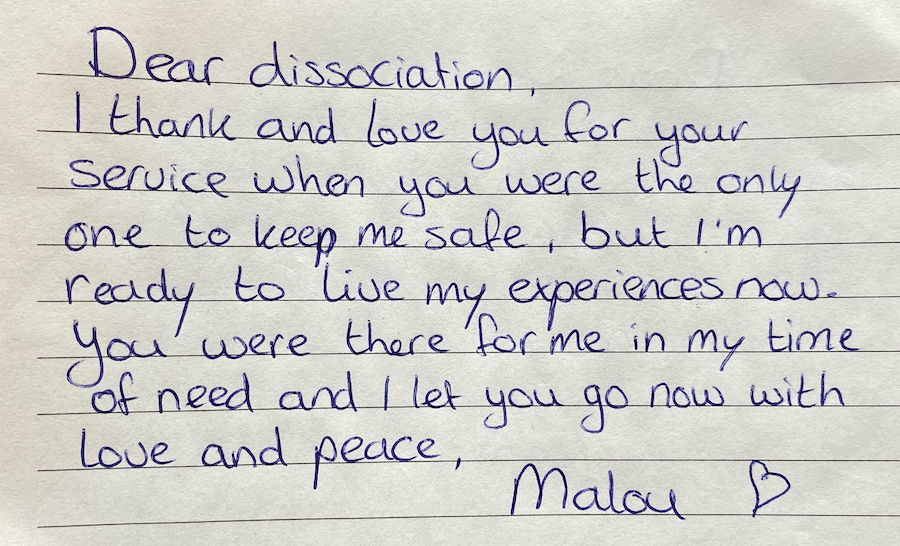
Writing the letter made me realise that so many of the things I was trying to fight simply needed love and acknowledgement. This love towards it softened it’s grip on me and symptoms such as dissociation have lessened massively.
This brought me back to questioning the meaning of Tapas. Are we even really practicing yoga when we do so from a harsh discipline? What if the intention or fuel behind the discipline is more important than the action? What if Tapas is about love? I’ve struggled a lot with my practice this year, but after several months I feel like my practice is progressing again with a new understanding of discipline. I practice because I love to practice, and I practice with love for myself and this world. The next time I’ll feel those pins and needles in my legs, I might actually move because kindness towards myself doesn’t make me less of a yogi.
Thank you Malou, keep sharing your insights, you have the capacity to describes the states we are all going through while opening to life with the most important qualities developed with yoga, clarity and detachment. The inner critic is a big one to fully welcome within, it takes so many shapes. And the next time you feel pins and needles in your legs you have now increased your freedom to choose.
With joy, Santosh.
Thank you for your comments Santosh! That’s really nicely put ‘the freedom to choose’.